Running Generate Smart Groups Commands
 Use the Smart Groups button to access the dialog box to run a Generate Smart Groups command. This command triggers the service to generate groups based on a set of "smart" rules and conditions. You can also run the command manually from this page.
The Smart Group definition and its component rules must be configured prior to running the Generate Smart Groups command. Use the Extended Options button on the Commands menu to access configuration details. See Configuring Extended Command Options and Configuring Smart Group Definitions for more information.
The command can also be initiated by scheduling the Generate Smart Groups command in the Master Scheduling Service (MSS) in CygNet Explorer (most common usage), or via scripting.
See FMS Commands and Generate Smart Groups for more information about this command.
See Scheduling FMS Command Tasks in the MSS for more information about scheduling commands.
See FMS ActiveX Controls and CxHmiFms for more information about using commands via FMS ActiveX controls on CygNet Studio or CygNet Vision screens.
See CxFms for more information about scripting commands.
Managing Generate Smart Groups Commands
Prior to running a Generate Smart Groups command, verify or configure the definitions and rules referenced by the command.
Click Extended Options > Smart Group Configuration on the Commands menu to view, add, edit, or delete definitions and rules for the Generate Smart Groups command. See Configuring Smart Group Definitions for more information.
Running a Generate Smart Groups Command
Most Generate Smart Groups commands will be run via scheduled tasks. See Scheduling FMS Command Tasks in the MSS for more information.
Use the following procedure to run a Generate Smart Groups command manually.
To Run a Generate Smart Groups Command
- Configure or verify smart groups definitions and rules via the Extended Options button. See Configuring Smart Group Definitions for more information
- On the Commands menu, click Smart Groups to access the Run FMS Command dialog box for the Generate Smart Groups command.
|
Run FMS Command |
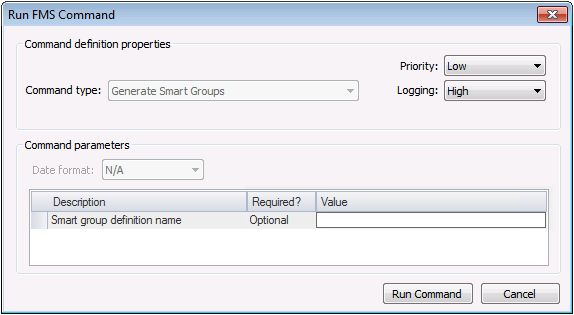
- Define the command definition properties.
- Select a processing Priority from the drop-down menu. Options include Low, Medium, High, User, and Admin.
- Select a Logging level from the drop-down menu, to determine the level of logging details reported when viewing command logs. Options include Low, Medium, and High. See Viewing Command Logs for more information.
- Define the command parameters, to specify what smart group definition(s) to use.
Note: The parameters for the Generate Smart Groups system command are too extensive to be described in the Command parameters box, so they are configured through the Extended Options button on the Commands menu. See Configuring Smart Group Definitions for more information.
- Click Run Command.

Command Definition Properties
The following command definition properties apply to Generate Smart Groups commands.
| Property | Description |
|---|---|
|
Command type |
For system commands, this property will be read-only and will display the selected command type. See FMS Commands for more information about command types. |
|
Priority |
Select a processing queue Priority for the command from the drop-down menu. Options from least to greatest priority are as follows.
Default value is Low level processing queue priority. |
|
Logging |
Select a Logging level for the command results from the drop-down menu. Options are as follows.
Default value is Low level logging when scheduling a command in the MSS. Default value is High level logging when creating or running an ad-hoc command in FMS Explorer. |
Command Parameters
Generate Smart Groups command parameters are configured through the Commands menu via the Extended Options button, prior to running the command. See Configuring Smart Group Definitions for more information.
| Description | Required? | Value |
|---|---|---|
|
Smart group definition name |
Optional |
If used, type a smart group definition name into the text box. Type in a partial name, in conjunction with wildcard(s), to select multiple definitions matching the description. Wildcard values * (multiple character) and ? (single character) are supported. See Configuring Smart Group Definitions for more information. This parameter is optional. If not provided, the default value is * (multiple character wildcard); run the command for all smart group definitions. |

